How to Choose Tech Stack: A Guide on how to choose tech stack for Growth
Learn how to choose tech stack that accelerates your launch and boosts ROI. A founder-friendly guide with data-backed steps to fuel sustainable growth.

Choosing your tech stack is a foundational business decision, not just a technical one. The right choices have a massive impact on your speed, your budget, and your ability to actually make money.
The goal isn't to chase the trendiest new framework. It's to align your technology with what really matters for an early-stage company: speed to market and user retention. Get this right, and you're building a foundation that supports revenue and growth from day one.
Making Your First and Most Important Tech Decision
Founders often treat the tech stack as a task to delegate to the first engineer. That's a huge mistake.
This single decision will dictate your development speed, how much you burn on salaries, your hiring pipeline, and how quickly you can show investors real traction. It’s a choice that echoes through every single stage of your startup’s life.
The conversation should never start with, "What's the coolest new framework?" It needs to begin with, "What do we absolutely need to achieve as a business, right now?"
This simple shift changes everything. For example, instead of debating the merits of Rust for its performance, you ask: "Can we find enough affordable Rust developers to build our MVP in three months?" The practical business constraint immediately grounds the technical discussion.
Aligning Technology with Business Goals
For any startup trying to find its footing, the mission is brutally simple: ship fast, get user feedback, and find a way to get paid. That's it. Your tech stack is just a set of tools to get that done. It's not a science project.
Keeping this practical mindset helps you sidestep the trap of over-engineering and stay focused on what will actually move the needle.
Before you fall in love with any piece of tech, run it through this filter:
- Speed to Market: How fast can a small team build and iterate with this? A quicker launch means quicker feedback, which is the lifeblood of a startup. Actionable Insight: A framework with a rich library of pre-built UI components can shave weeks off development time compared to one that requires building everything from scratch.
- Monetization Readiness: Can we easily plug in payments, subscriptions, or in-app purchases? This can't be an afterthought - it’s the whole point. Actionable Insight: Check if your chosen stack has official, well-maintained SDKs for services like Stripe or RevenueCat. If it doesn't, you're signing up for a lot of custom, error-prone work.
- Hiring and Talent: Can I find and afford developers who know this stuff? A niche, "cool" technology can quickly become a hiring nightmare that grinds you to a halt. Actionable Insight: Before committing, search for developers with that skill on LinkedIn in your city. If you see hundreds of profiles, you're in a good spot. If you see a dozen, you have a problem.
- Maintainability and Handoff: When we eventually hire a real team, are we handing them a clean slate or a tangled mess? Smart choices today prevent crippling technical debt tomorrow. Actionable Insight: Choose technologies with strong, long-term corporate backing (like React Native by Meta or Flutter by Google) as they are less likely to be abandoned, ensuring ongoing support and updates.
To help you stay focused, here's a quick summary of the core criteria. Think of this as your cheat sheet for every tech conversation.
Core Tech Stack Decision Criteria for Founders
| Decision Criterion | Why It Matters for Your Startup | Key Question to Ask |
|---|---|---|
| Speed to Market | Getting to first revenue and user feedback is a race against your runway. Faster is always better. | Can a small team build and ship an MVP in weeks, not months, with this stack? |
| Monetization | A product that can't take money isn't a business. Monetization features can't be an afterthought. | Does this stack have mature, well-documented libraries for payments and subscriptions? |
| Talent Availability | A niche stack means a smaller, more expensive talent pool, slowing down hiring and increasing burn. | Can I find 10 qualified and affordable developers for this stack on LinkedIn in my city today? |
| Maintainability | The code you write today will be maintained by someone else tomorrow. Technical debt kills velocity. | Is this stack well-documented, widely adopted, and easy for new developers to understand? |
These questions force you to connect technical choices directly to business outcomes. It's the most effective way I've found to cut through the noise and make pragmatic decisions that serve the company's real needs.
The Power of Cross-Platform Frameworks
For most early-stage startups, the decision-making process leads directly to one place: cross-platform frameworks. They are the single biggest lever you can pull to slash development costs and get to market faster.
For a Series A company racing to prove traction before the next fundraise, this is non-negotiable.
Look at the data. As of 2026, a staggering 18,873 verified companies around the world are using React Native, including behemoths like Amazon and Microsoft. Why? Because adopting React Native can save up to 40% on development costs compared to building separate native apps, and its component-based architecture can speed up the actual coding by 60%.
Choosing a stack like this has a massive ripple effect on your ability to improve developer productivity. If you want to go deeper on this, we've written a complete guide on app development for startups.
Translating Business Goals into Technology Choices
Every tech choice you make is a trade-off. Let’s get that out of the way. There’s no silver bullet, no single “best” tech stack - only the one that’s right for your business, right now. The real skill is turning your big-picture business goals into concrete, defensible technology decisions. This isn’t about gut feelings; it’s about a structured thought process.
The main challenge? Mapping your specific objectives to a set of technical criteria. Are you building a social media app that needs to survive going viral overnight? Or are you building a healthtech platform where data security and HIPAA compliance are non-negotiable? The answers push you down entirely different technology paths.
Think about a startup laser-focused on rapid user acquisition for its MVP. Their primary goal is getting user feedback, fast. That means favoring frameworks known for speed. A tool like React Native lets you ship on both iOS and Android from a single codebase - a massive win when market validation is everything. It's a strategic choice to prioritize speed to market over, say, raw, native performance.
But flip the script. What if your app leans heavily on device hardware? Imagine an augmented reality (AR) app like Pokémon GO that uses the absolute latest camera and GPS features. In that world, native development in Swift or Kotlin is probably the only real option. The business goal of a polished, high-fidelity user experience dictates a more specialized - and often more expensive - path.
Building Your Decision Matrix
To make these trade-offs tangible, you need a decision matrix. This isn’t just a fancy spreadsheet. It’s a tool that forces you to turn strategic priorities into a quantifiable decision, compelling you to weigh competing factors against each other. It helps you defend your final choice with data, not just opinion.
Your matrix has to be tailored to your context. A B2B SaaS platform focused on enterprise security has completely different priorities than a D2C social media app.
Start by framing your discussion around these four pillars:
- Development Velocity: How fast can your team build and ship? This is your speed to market, plain and simple.
- Ecosystem & Talent: How big and mature is the community around the technology? More importantly, can you actually hire skilled developers for it without blowing your budget?
- Long-Term Cost of Ownership: Don't just think about the initial build. What are the ongoing costs of maintenance, hosting, and future updates?
- Scalability & Performance: Can this technology handle your user growth projections? Will it buckle under pressure right when you start to get traction?
By assigning a weight to each criterion based on your business goals, you create a scoring system. This turns a subjective debate ("I like this framework better") into an objective evaluation, making it crystal clear which tech stack truly aligns with your strategy.
This simple decision tree shows how your primary business drivers should guide your thinking.
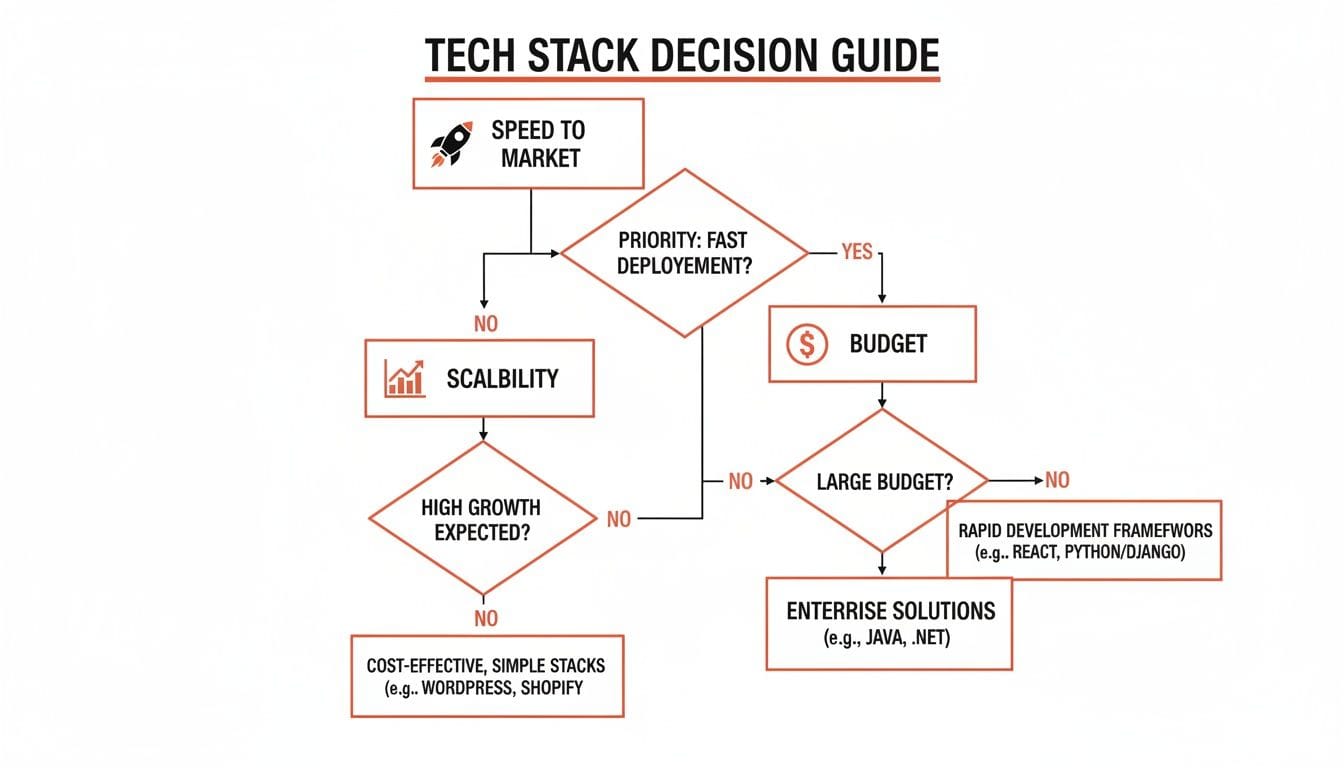
The key takeaway here is that there’s no single right answer. The "best" stack is a direct result of your most critical business need at this very moment.
A Practical Example: A Social Networking MVP
Let’s make this real. Imagine you’re building a new social app for a niche community. Your business goals are clear:
- Validate the core idea with a working MVP, quickly.
- Launch on both iOS and Android to grab the biggest possible audience from day one.
- Keep initial development costs low to make your seed funding last.
Given these goals, your decision matrix would heavily weight Speed to Market and Low Initial Cost.
Here’s how two potential stacks might score in this scenario:
| Criterion (Weighted) | React Native Stack (Score 1-5) | Native Stack (Swift/Kotlin) (Score 1-5) |
|---|---|---|
| Speed to Market (Weight 5) | 5 (Single codebase for both platforms) | 2 (Requires two separate codebases) |
| Talent Availability (Weight 4) | 4 (Large pool of JavaScript/React devs) | 3 (Requires specialized iOS & Android devs) |
| Initial Cost (Weight 5) | 5 (One team builds for both platforms) | 2 (Need to hire or contract two teams) |
| Peak Performance (Weight 2) | 3 (Excellent for most apps) | 5 (Unmatched access to native APIs) |
| Total Score | 68 | 43 |
In this scenario, the React Native stack is the obvious winner with a score of 68 versus 43. You're making a conscious trade-off: accepting slightly lower peak performance in exchange for huge gains in speed and cost-efficiency. For an MVP, that's almost always a smart bet.
This matrix makes the final decision logical and defensible. When you define your priorities first, the right technology choices often become surprisingly clear.
Cross-Platform vs. Native: Your First Big Fork in the Road
For any founder building a mobile-first company, this is the most critical decision you'll make. Choosing between a single cross-platform app or two separate native apps for iOS and Android isn't just a technical detail - it's a strategic move that will define your budget, team structure, and how fast you get to market.
The goal here isn't to crown a winner. It's to lay out the real-world business implications of each path so you can make the right call for your company.
This choice directly impacts your ability to compete. For a seed-stage startup, using a cross-platform framework like React Native means you can launch on both iOS and Android at the same time. You’re preserving precious capital by using one codebase and one dev team, effectively doubling your market reach on day one without doubling your engineering costs.
It’s all about a calculated trade-off. You might give up a tiny fraction of peak performance for a massive gain in development speed and cost efficiency. When you're in a race to find product-market fit, that’s almost always the right bet.
The Case for Cross-Platform
The core value of cross-platform is pure efficiency. When you write code once and deploy it everywhere, you fundamentally change your operational reality. This isn't just a theory; it's been proven at a massive scale.
Look at Discord. They managed an incredible 98% code sharing between their iOS and Android apps using React Native. This allowed their small team to ship a consistent, high-quality experience to millions of users without managing two separate engineering departments.
That’s why React Native has become so dominant. By 2026, it powers apps for 18,873 companies, from the $681B giant Walmart to IBM. While other frameworks exist, React Native's massive talent pool - boasting a 1.4:1 developer ratio over competitors like Flutter - and its use by 41.6% of professional developers makes hiring so much easier.
This all translates into tangible results: potential 40% cost savings and 60% faster build times.
Cross-platform isn't about compromise; it's about strategic resource allocation. When speed and budget are your biggest constraints, leveraging a single codebase is the most powerful tool you have to get your product into users' hands faster.
When to Go Native
But cross-platform isn't a silver bullet. There are absolutely times when going native - using Swift for iOS and Kotlin for Android - is the only viable path. The decision to go native almost always comes down to performance and deep hardware integration.
Native development is the non-negotiable choice when your app’s core value relies on:
- Intensive Graphics and Animation: Think high-end mobile games like Genshin Impact, complex photo editing software like Adobe Lightroom, or AR/VR experiences that need to squeeze every last drop of performance from the device’s GPU.
- Deep OS Integrations: If your app needs to talk directly to low-level device features like advanced camera APIs, specific Bluetooth protocols for connecting to hardware, or unique background processing modes for health tracking, native code gives you the most direct and reliable access.
- Cutting-Edge Platform Features: When Apple or Google drops a brand-new feature (like Live Activities for iOS or advanced widgets for Android), native SDKs get access first. If being a first-mover is part of your competitive edge, native is the only way to go.
A perfect example is a healthtech app like Oura Ring, which needs to process sensor data from a wearable in real-time via Bluetooth Low Energy. The performance and reliability demands of a product like that easily justify the higher cost and slower build time of native development. In these cases, going native isn't a luxury; it's a product requirement.
For a more detailed breakdown of these scenarios, our in-depth guide covers the specific React Native vs Native development trade-offs.
Making the Call: A Practical Comparison
The final decision comes down to weighing these trade-offs against your specific business goals. To help you think through it, here’s a practical comparison of the two main approaches.
React Native vs Native Development Trade-Offs
| Factor | React Native (Cross-Platform) | Native (iOS/Android) | Best For... |
|---|---|---|---|
| Speed to Market | Excellent. A single codebase and team allows for rapid MVP development and simultaneous launches. | Fair. Requires two separate development cycles, effectively doubling the time to market. | Startups needing to validate an idea quickly and capture the entire market at launch. |
| Development Cost | Lower. One team and one codebase significantly reduce salary and operational expenses. | Higher. Requires hiring specialized, and often more expensive, iOS and Android developers. | Companies with tight budgets where capital efficiency is the top priority. |
| Performance | Very Good. Modern architectures deliver near-native performance for over 95% of app use cases. | Excellent. Unmatched raw performance and direct access to all device hardware and OS features. | Apps with demanding graphical needs or those requiring complex, low-level device interactions. |
| Team Management | Simpler. A single team of JavaScript/React developers can manage the entire mobile product. | More Complex. Requires managing two distinct teams with different skill sets, roadmaps, and release cycles. | Lean teams looking to simplify communication and reduce management overhead. |
Ultimately, this choice is a mirror of your business strategy.
If your primary goal is to launch fast, learn from your users, and do it all in the most capital-efficient way possible, React Native is a powerful and proven path. If your product's core value is tied to elite performance or a unique feature that only native code can deliver, then investing in native development is a necessary and strategic decision.
Architecting a Revenue-Ready Stack from Day One
Let's be blunt: an MVP that can't prove a monetization model is just an expensive prototype. Treating revenue features as an add-on is a critical, and painfully common, mistake. Monetization isn’t something you bolt on later; it needs to be a core architectural decision from the very first line of code.
This means engineering a "money layer" directly into your application from the start. Your stack has to seamlessly handle payments, manage tricky subscription logic, and track the user events that actually lead to a conversion. Choosing your tech without first validating its ability to do this is a recipe for a painful and expensive rewrite down the line.
Building the Core Money Layer
The money layer is simply the collection of services and APIs that handle every part of your revenue model. For most mobile-first startups, this usually means getting a few key components to work together.
- Payment Gateway: This is the engine that actually processes credit card transactions. Stripe is the undisputed king here. Their developer documentation is excellent and their APIs make integrating payments about as straightforward as it gets.
- Subscription Management: Let's be honest, handling the logic of in-app purchases (IAP) across both Apple and Google is a notorious headache. A service like RevenueCat acts as a brilliant wrapper around the native StoreKit and Google Play Billing libraries. It simplifies everything from trial management to renewals and checking who's entitled to what.
- A Reliable Backend: Your backend is the glue holding this all together. It needs to talk securely with your payment gateway, store customer subscription status, and manage user data without breaking a sweat.
Selecting a Backend That Supports Monetization
Your choice of backend-as-a-service (BaaS) directly impacts how well you can build out these money-making features. Not all BaaS platforms are built the same when it comes to the specific needs of a revenue-focused app.
A platform like Firebase or Supabase is often a strong starting point for an MVP. They offer secure, scalable databases and, crucially, cloud functions. These functions are where you'll handle server-side logic, like validating a purchase with RevenueCat's servers or creating a new customer record in Stripe.
When you're evaluating a backend, you have to make sure it has well-supported SDKs and clear documentation for these kinds of server-side jobs. It’s a vital step when thinking about the entire web of APIs for microservices your app will depend on.
A tech stack without integrated analytics is like flying blind. Monetization isn't just about processing a payment; it's about understanding the entire user journey that leads to that payment. You cannot optimize what you cannot measure.
Analytics and Growth Tools Are Non-Negotiable
Integrating analytics from day one isn't a "nice-to-have" - it's a fundamental requirement for building a real business.
Tools like Amplitude or Mixpanel let you track user behavior in incredible detail. This data is what allows you to answer the most important questions you have:
- Where are users dropping off in our onboarding funnel?
- What specific actions do paying customers take that free users don't?
- How did that new feature really impact user retention and conversion?
Without this data, you’re just guessing. In the same vein, growth tools like push notifications (via Firebase Cloud Messaging) or marketing automation platforms are essential for re-engaging users and nudging them toward those key monetization events.
Case Study: A Subscription App's Revenue-First Stack
Imagine a consumer subscription app for guided meditation. Their one and only goal is to convert free users to a monthly or annual plan.
Their revenue-ready stack was chosen specifically to make this flow as smooth as possible:
- Frontend: React Native (for its speed and single codebase).
- Backend: Firebase for Firestore (their database) and Cloud Functions.
- Subscriptions: RevenueCat to manage all the messy IAP logic.
- Payments: Stripe, ready for future web-based payments.
- Analytics: Amplitude to map the user journey from the first session all the way to a subscription.
By integrating Amplitude from the start, they quickly discovered that users who completed three sessions in their first week were 5x more likely to subscribe. That's a huge insight.
Armed with that knowledge, they set up automated push notifications through Firebase to encourage new users to hit that magic number. This single, data-driven optimization loop - made possible by their initial stack choice - directly increased their trial-to-paid conversion rate by 15% in the first quarter after launch.
Future-Proofing Your Stack for Scale and Handoff
The tech stack you pick for your MVP does more than just get you to launch. It’s the foundation for your ability to grow, hire, and eventually bring development in-house. Sure, speed is everything right now, but if that speed creates a maintenance nightmare down the road, you’ve just kicked the can.
Future-proofing isn't about gazing into a crystal ball. It’s about making smart choices today that give you options tomorrow.
This means you have to think beyond just shipping the product. Every decision - from your frontend framework to your backend language - has a direct and lasting impact on your business. A smart choice opens doors to talent and scale. A poor one grinds your progress to a halt with technical debt.
The Hidden Costs of Your Framework Choice
Here’s something most founders miss: every technology choice is a hiring choice.
When you select a framework, you’re also defining your talent pool. If you pick a niche, esoteric language because a developer thinks it’s cool, you’re also opting into a smaller, more competitive, and more expensive hiring market. This isn’t a theoretical problem. It's a real-world bottleneck that can cripple your ability to scale your team when you need it most.
For early-stage companies, popular, well-established technologies offer a massive strategic advantage.
Choosing a widely adopted framework isn't "playing it safe"; it's a strategic decision to prioritize access to a deep pool of qualified engineers. This ensures you can hire faster, onboard new team members more efficiently, and keep your development velocity high as the team grows.
Performance and cost stats often guide these picks for a reason. Take React Native. It can offer a 40-60% faster time-to-market. Its modern architecture delivers a respectable 45-50 FPS under heavy load - approaching Flutter's 60FPS but with the backing of giants like Coinbase who have proven its ability to scale to millions.
Critically, it can offer up to 40% cost savings over native development, a huge factor when maintenance often eats up over 70% of software budgets. With a larger talent pool than its competitors and the familiarity of JavaScript cutting down the learning curve, it’s an excellent choice for post-launch optimization and the eventual team handoff. You can learn more about these findings on mobile framework comparisons.
Architecting for Scalability and Maintainability
Building for scale doesn't mean architecting for a million users on day one. It means building in a way that doesn't require a complete rewrite when you get there. This comes down to architectural patterns that favor modularity and a clear separation of concerns.
Instead of a tightly coupled monolith where every component depends on every other, your team should be considering patterns that allow for independent work. This could mean using a backend-for-frontend (BFF) pattern or designing your services around clear API boundaries. For long-term viability and ease of handoff, it's also crucial to select the right cloud infrastructure automation tools that can adapt as you grow.
This approach pays huge dividends in maintainability. When a new developer joins the team, they don’t need to understand the entire system just to fix a bug in one small part. That slashes onboarding time and makes your entire engineering org more efficient.
Planning for the Inevitable Handoff
If you’re working with an external agency or dev shop, the handoff to your own in-house team is a critical, and often botched, stage. A successful transition doesn't just happen - it requires deliberate planning from day one.
The goal is simple: ensure the team you hire can take ownership of the codebase and infrastructure without a massive drop in productivity. A rushed or poorly planned handoff can destroy all the momentum you’ve built.
Treat this transition like a key project milestone and use a checklist to make sure nothing falls through the cracks.
Handoff Readiness Checklist
- Comprehensive Documentation: Is there clear, up-to-date documentation for the architecture, key business logic, and setup instructions for a new developer’s machine? Example: A well-documented
README.mdfile in the code repository with a "Getting Started" section is a great start. - CI/CD Pipelines: Are the build, test, and deployment processes fully automated? A new engineer should be able to merge a small change and see it deployed to a staging environment without manual intervention. Example: Using tools like GitHub Actions or CircleCI to automatically run tests and deploy to a test server on every code commit.
- Knowledge Transfer Sessions: Have you scheduled dedicated sessions for the outgoing team to walk the new team through the codebase, infrastructure, and release process? Example: A recorded video walkthrough of the core application flow and deployment process that new hires can reference later.
- Credential and Ownership Transfer: Are all third-party service accounts, domain names, and code repositories fully owned by your company? Example: Using a password manager like 1Password to securely transfer ownership of accounts for AWS, Google, and Apple Developer portals.
- Post-Handoff Support: Is there a clear agreement for a short-term support period where the new team can ask questions and get help with any unexpected issues? Example: A shared Slack channel and two weeks of scheduled on-call support from the original development team.
By treating the handoff this seriously, you ensure the speed you gained in the early days translates into sustainable, long-term velocity.
Common Tech Stack Questions, Answered
Even with the best framework, you're going to hit some practical, "what-if" questions when picking a tech stack. I've seen founders wrestle with these exact same issues time and again. Here are some quick, no-BS answers to the most common ones.
How Often Should I Re-Evaluate My Stack?
Almost never. A full rewrite is one of the classic startup death traps. It burns cash, kills momentum, and is usually driven by ego, not business needs. Don't chase shiny new tech.
Instead, you should only consider a major re-evaluation at very specific inflection points.
- You've Hit Product-Market Fit: The stack that got you your first 1,000 users will almost certainly buckle under the weight of 1,000,000. Once you have real traction and know your core product works, it’s time to ask if your tech can handle the next order of magnitude. Example: A social media app built on Firebase might need to migrate to a more scalable custom backend with a database like ScyllaDB once it hits millions of daily active users.
- A Major Strategic Pivot: Are you moving from B2C to B2B? Launching a completely new product line? Expanding to a new continent? These kinds of fundamental business shifts can introduce requirements your current stack was never designed for. Example: A consumer photo-sharing app pivoting to an enterprise digital asset manager will need to add features like role-based access control and detailed audit logs, which might necessitate a backend language change to something like Java or C#.
- The Tech is a Blatant Blocker: If performance issues are killing your retention, or you literally can't hire engineers fast enough because your stack is too niche, the technology itself has become an obstacle to hitting your KPIs. Only then is it time to act.
What's the Biggest Mistake Founders Make When Choosing?
Easy. Choosing a stack based on what’s trendy or what they personally know how to use, instead of what the business actually needs. This is "resume-driven development" or "founder preference" bias, and it's incredibly costly.
I've seen founders insist on using a niche functional programming language because it’s intellectually cool. It might be elegant, but it shrinks the talent pool from thousands of available engineers to a handful of expensive, hard-to-find specialists. Hiring becomes a nightmare.
Always work backward from your business goals. Start with what matters - speed to market, budget, the talent you can actually hire, your monetization model - and then pick the tech that serves those priorities. Your market dictates your stack, not your personal preferences.
Can I Mix and Match Different Technologies?
Absolutely. In fact, you pretty much have to. A modern application isn't a monolith built with one language; it's an ecosystem of specialized tools, each chosen because it's the best at what it does.
It's completely normal to build your mobile app with a cross-platform framework like React Native while your backend is a totally different world. For example:
- Node.js: A popular choice because you can use JavaScript/TypeScript on both the front and back end, which simplifies hiring. Best for: General-purpose applications, real-time apps like chat, and APIs.
- Python (with Django or Flask): The go-to if your app has any data science or machine learning features. Best for: AI-powered recommendation engines or apps that need heavy data analysis.
- Go: A powerhouse for high-performance, high-concurrency services that need to handle a massive load. Best for: Infrastructure tooling, or the core microservice that handles your highest volume of traffic.
The trick is making sure these different pieces talk to each other cleanly through well-defined APIs, usually using REST or GraphQL. This approach lets you pick the best tool for each specific job - like React Native for its UI development speed and Go for its raw backend power - without making compromises.
At Vermillion, we've been in the trenches helping startups navigate these critical decisions. We architect and build revenue-ready mobile products that are actually aligned with your business goals. Learn how we can accelerate your path to market.